
By Alfonso Davis October 4, 2026
A business can lower processing fees on large B2B invoice payments by identifying eligible commercial cards, qualifying transactions for the correct Large Ticket interchange treatment, transmitting required enhanced data through the gateway and acquirer, confirming that lower interchange reaches the merchant, and comparing the resulting all-in card cost with ACH on very large invoices.
A percentage-based card cost becomes much more noticeable as invoice size increases. An illustrative 2.90% processing cost equals only $5.80 on a $200 payment, but it becomes $725 on a $25,000 invoice and $2,900 on a $100,000 invoice.
That does not mean large B2B customers should automatically be pushed away from cards. Commercial-card interchange programs, Level 2 and Level 3 data, gateway configuration, processor pricing, and ACH can all change the economics.
The practical objective is to lower processing fees on large B2B invoice payments while preserving the payment methods customers actually need.
Why Large B2B Card Payments Become So Expensive
The first step is understanding what the merchant is paying.
Interchange is a network-defined fee associated with the movement of a card transaction between the acquiring and issuing sides. It is only one part of the merchant’s total card-acceptance cost.
A merchant may also pay:
- card-network fees and assessments;
- processor or acquiring markup;
- authorization or transaction charges;
- gateway charges;
- monthly or account fees;
- enhanced-data or integration costs, depending on the provider.
The merchant discount rate, or MDR, represents the broader merchant-facing cost of accepting cards. Interchange and MDR are therefore not interchangeable terms.
Visa expressly distinguishes interchange reimbursement fees from the merchant discount paid by a merchant to its financial institution. Mastercard similarly describes interchange as one component of MDR.
That distinction is essential when reviewing merchant discount rate B2B costs. A transaction can qualify for lower interchange while other fees remain unchanged.
$25,000 invoice example
Assume a distributor processes a $25,000 invoice at an illustrative all-in processing rate of 2.90%.
$25,000 × 2.90% = $725
Now assume changes to legitimate interchange qualification and pricing reduce the merchant’s all-in effective rate to an illustrative 2.40%.
$25,000 × 2.40% = $600
Difference:
$725 − $600 = $125
These are hypothetical merchant-facing rates, not claims about typical market pricing.
Use this formula with actual processing statements:
Effective rate = total processing cost ÷ gross card sales × 100
For businesses trying to lower processing fees on large B2B invoice payments, that effective rate is usually more useful than concentrating on a single advertised processor percentage.
What a Large Ticket Interchange Program Actually Does
A large ticket interchange program is a card-network interchange treatment for eligible high-value commercial transactions. It is not an automatic processor discount given simply because an invoice is large.
Commercial payment cards can include purchasing cards, corporate cards, specialized commercial credit products, and other network-defined business products. Networks can apply different interchange structures to those transactions when specific program requirements are met.
The important point is that Visa and Mastercard do not use identical Large Ticket structures.
Rates and program details verified: October 2026. Network interchange schedules and qualification rules can change; confirm the current schedule with the card network and acquiring processor before implementation.
Visa’s current U.S. interchange reimbursement fee schedule, effective April 18, 2026, publishes Commercial Product Large Ticket at 1.30% + $35.00 for its Purchasing and Corporate T&E category.
The same Visa table publishes:
- Commercial Product 3: 1.75% + $0.10
- Commercial Card Present: 2.50% + $0.10
- Commercial Card Not Present: 2.70% + $0.10
- Non-Qualified: 2.95% + $0.10
- Commercial Product Large Ticket: 1.30% + $35.00
Mastercard’s current U.S. Region interchange programs and rates, effective April 17, 2026, separately publishes Large Market Credit Large Ticket at 1.45% + $35.00.
Mastercard also publishes a distinct tiered program for Commercial Payments Account transactions.
Visa vs. Mastercard Large Ticket structure
| Feature | Visa | Mastercard |
| Published program relevant here | Commercial Product Large Ticket | Large Market Credit Large Ticket |
| Published rate | 1.30% + $35 | 1.45% + $35 |
| Separate high-value programs | STP and Large Purchase Advantage also appear | Commercial Payments Account tiers also appear |
| Explicit transaction bands for the row above | Not shown in the Commercial Product Large Ticket row | Not shown in Large Market Credit Large Ticket row |
| Separate amount-based schedule | Yes, for other programs such as STP and Large Purchase Advantage | Yes, Commercial Payments Account |
| Enhanced-data considerations | Commercial Level 2/3 capabilities are separately documented | Enhanced data can be part of qualification criteria |
| Acquirer confirmation needed | Yes | Yes |
This network-by-network distinction is one of the most important steps when trying to lower processing fees on large B2B invoice payments.
Do not let a processor take a Visa threshold, Mastercard tier, or Level 3 requirement and present it as a rule that applies to both networks.
Do Not Confuse Visa Large Ticket, STP, and Large Purchase Advantage
Visa’s current commercial schedule contains several high-value programs. They should not be treated as interchangeable names.
For Straight Through Processing, or STP, Visa currently publishes:
| Transaction amount | STP interchange |
| Less than $7,000 | 2.00% + $0.10 |
| 7,000–14,999.99 | 1.30% + $35 |
| 15,000–49,999.99 | 1.10% + $35 |
| 50,000–99,999.99 | 0.95% + $35 |
| $100,000 and greater | 0.80% + $35 |
Visa separately publishes Large Purchase Advantage for eligible Visa Purchasing transactions. For card-not-present transactions, its published schedule changes above $10,000 and then uses additional bands through transactions greater than $500,000.
Those are separate programs from the Commercial Product Large Ticket row.
That distinction prevents a common error: assuming Visa has one universal Large Ticket threshold because another Visa commercial program has published amount bands.
If the public schedule does not disclose the qualification requirement for the specific category being discussed, confirm the current requirement with the acquirer or Visa rather than guessing.
How Much Can Large Ticket Interchange Change the Economics?
Large Ticket qualification can change the interchange component substantially on a high-value invoice. It does not guarantee that the merchant’s total processing cost will fall by exactly the same amount.
Visa $25,000 example
Compare two currently published Visa commercial rates.
Commercial Product Large Ticket
$25,000 × 1.30% = $325
$325 + $35 = $360.00
Commercial Product 3
$25,000 × 1.75% = $437.50
$437.50 + $0.10 = $437.60
Difference:
$437.60 − $360.00 = $77.60
Mastercard $25,000 example
Mastercard publishes the following rates for its Large Market Credit product:
Large Ticket
$25,000 × 1.45% = $362.50
$362.50 + $35 = $397.50
Data Rate III
$25,000 × 1.90% = $475
$475 + $0.10 = $475.10
Difference:
$475.10 − $397.50 = $77.60
This is an interchange comparison, not a guaranteed merchant statement savings quote.
It does not mean Commercial Product 3 or Data Rate III is automatically the fallback whenever Large Ticket qualification fails. The examples simply show how two published categories differ mathematically.
Network charges, processor markup, gateway costs, and contractual pricing can still remain.
That is why merchants attempting to lower processing fees on large B2B invoice payments should verify both the interchange result and the final merchant-facing cost.
Mastercard Commercial Payments Account Has Its Own Large Ticket Tiers
Mastercard’s Commercial Payments Account structure deserves separate treatment because its public schedule provides explicit transaction bands.
| Transaction amount | Published CPA rate |
| Less than $10,000 | Commercial rates apply |
| 10,000–25,000 | 1.20% |
| 25,000.01–100,000 | 1.00% |
| 100,000.01–500,000 | 0.90% |
| 500,000.01–1 million | 0.80% |
| More than $1 million | 0.70% |
The table does not show a separate fixed-dollar component for those CPA Large Ticket tiers.
The $10,000 threshold is therefore valid for the Mastercard Commercial Payments Account program shown in this table. It should not be described as a universal Mastercard Large Ticket threshold, and it should never be transferred to Visa.
Which B2B Transactions Can Qualify?
Transaction amount is only one part of commercial-card qualification.
The card must be an eligible commercial product
Commercial payment products can include corporate cards, purchasing cards, Large Market Credit products, Commercial Payments Accounts, and other network-defined business products.
A high-dollar consumer rewards card does not become a commercial Large Ticket transaction because a customer charges $25,000 or $100,000 to it.
The amount must fit the applicable program
Some programs publish explicit amount bands. Others do not expose the full qualification threshold in the public rate table.
Mastercard’s Commercial Payments Account bands are explicit. Visa’s Commercial Product Large Ticket rate row does not publish its threshold in that table.
For an unpublished requirement, the correct instruction is:
Confirm the current requirement with your acquirer or card network.
Other qualification conditions can matter
Depending on the network and program, relevant conditions can include:
- commercial-card product;
- transaction amount;
- merchant category;
- authorization;
- authorization-to-clearing timing;
- clearing and settlement;
- required transaction information;
- enhanced transaction data;
- acquirer support;
- processor or MID configuration.
Mastercard’s current merchant documentation specifically explains that interchange categories have requirements that must be satisfied and identifies factors such as merchant category, authorization-to-clearing timing, transaction information, enhanced data, and merchant volume.
For a business seeking to lower processing fees on large B2B invoice payments, this means “the invoice is large” is never enough evidence by itself.
Large Ticket vs. Level 2 vs. Level 3: They Are Different

One of the most common B2B payments mistakes is treating Large Ticket and Level 3 as the same thing.
They are related concepts, but they answer different questions.
| Concept | What it means | Main purpose | Does invoice size alone qualify? |
| Standard commercial processing | Regular commercial-card treatment | Process business-card payments | No |
| Level 2 | Enhanced summary transaction information | Supply additional commercial data | No |
| Level 3 | Detailed enhanced and line-item information | Provide deeper purchasing/invoice data | No |
| Large Ticket | Network interchange category or high-value commercial program | Apply eligible high-value commercial pricing | No |
For readers researching level 2 level 3 data large ticket qualification, the key point is simple: enhanced data and Large Ticket qualification can interact, but they are not synonyms.
Visa documentation separately identifies commercial Level 2 and Level 3 enhanced-data capabilities. Mastercard likewise uses enhanced transaction information as part of commercial interchange qualification in appropriate programs.
Do not assume that every Large Ticket transaction requires an identical Level 3 record across Visa and Mastercard.
What Level 2 and Level 3 Data May Need to Be Sent?
Enhanced commercial data helps networks and issuers receive more information about a business purchase.
For Level 2-type transactions, commonly used information can include:
- customer code or customer reference;
- sales-tax information;
- transaction amount;
- purchase or order reference.
Level 3 records can go further and include line-item information such as:
- invoice or order number;
- product or commodity code;
- item description;
- quantity;
- unit of measure;
- unit cost;
- line-item amount;
- tax information;
- discounts;
- freight or shipping information;
- destination information.
These are examples of commonly transmitted enhanced-data elements, not a universal mandatory checklist for every Visa or Mastercard program.
The exact requirement depends on the card product, network program, processor, acquirer, gateway, and transaction context.
For teams working on level 2 level 3 data large ticket optimization, the most important question is not whether these fields exist in the ERP. It is whether the required fields reach the network correctly.
The Hidden Failure Point: The Gateway May Not Pass the Data
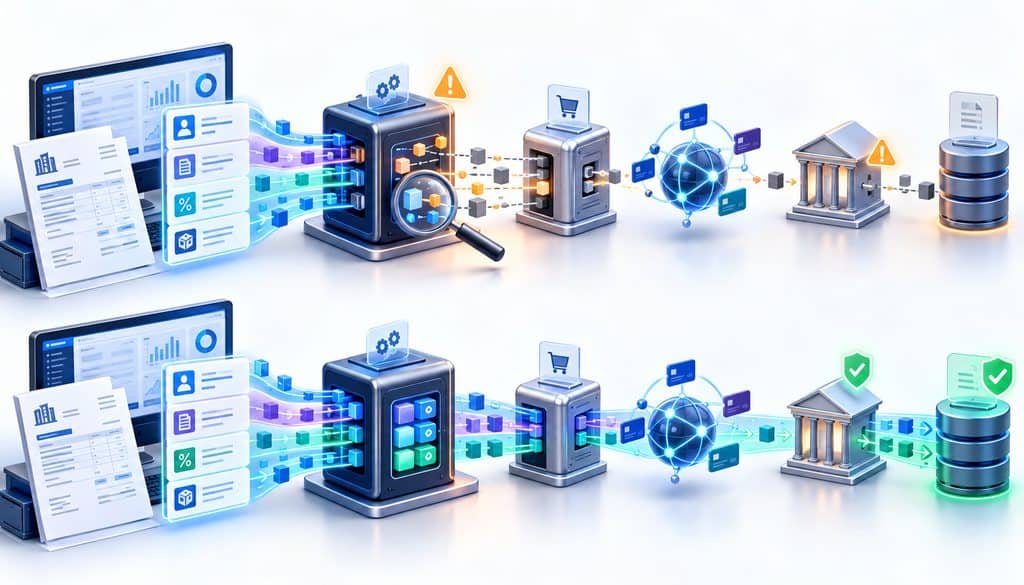
The normal information path looks like this:
ERP or invoicing platform → payment gateway → processor/acquirer → card network → issuer
A merchant can have perfect invoice data in its accounting system and still fail to receive the expected interchange treatment.
Common failures include:
- the gateway does not support the necessary enhanced fields;
- fields are available but not mapped;
- line-item detail never leaves the ERP;
- tax information is missing or invalid;
- the acquirer has not enabled the relevant capability;
- the transaction uses an ineligible card product;
- hosted checkout removes fields the merchant expected to send;
- the authorization and clearing records do not meet applicable requirements.
A “Level 3 supported” checkbox therefore does not prove that a settled transaction qualified.
This technical data path is often where businesses fail to lower processing fees on large B2B invoice payments, even after investing time in Level 3 integration.
How to Configure Large Ticket Processing
The most reliable approach is a short audit-and-test workflow.
Step 1 — Pull 60–90 days of large transactions
Collect:
- invoice amount;
- network;
- commercial versus consumer product where identifiable;
- current interchange category;
- interchange dollars;
- network fees;
- processor markup;
- gateway fees;
- total processing cost.
Focus first on transactions large enough to materially affect margin.
Step 2 — Ask the processor exactly what is enabled
Send a request such as:
“Please confirm whether our MID can qualify eligible Visa and Mastercard commercial transactions for the current Large Ticket programs. Please identify the exact Visa and Mastercard programs supported and confirm whether our gateway transmits the enhanced data required by your acquiring implementation.”
The exact program name matters.
Step 3 — Verify gateway capabilities
Ask whether the gateway can transmit:
- Level 2 data;
- Level 3 line-item data;
- network-specific commercial data;
- any additional fields required by the processor/acquirer.
Do not rely only on product-page claims.
Step 4 — Confirm the pricing model
Find out whether successful interchange qualification changes what the merchant actually pays.
Reviewing transparent pricing in merchant services can help separate underlying interchange from processor markup and bundled pricing.
Step 5 — Run real transactions
Test eligible transactions through the live processing flow.
Sandbox testing can confirm technical transmission, but settled production reporting determines the actual interchange result.
Step 6 — Review settled interchange detail
Ask the processor to identify:
- network;
- commercial product;
- interchange category;
- interchange dollars;
- processor markup;
- additional card fees.
This is the evidence needed to determine whether the configuration actually helped lower processing fees on large B2B invoice payments.
What to Get From the Processor in Writing
Ask the processor or acquirer to confirm:
- whether Visa Commercial Product Large Ticket is supported;
- which additional Visa commercial programs are available;
- whether Mastercard Large Market Credit Large Ticket is supported;
- whether Mastercard Commercial Payments Account processing is supported;
- eligible commercial-card products;
- applicable transaction-size conditions;
- any enrollment or MID configuration;
- Level 2 support;
- Level 3 support;
- fields required by the acquiring implementation;
- integration changes required;
- how qualification appears on interchange-detail reporting;
- processor markup;
- gateway or enhanced-data charges;
- treatment when qualification fails;
- whether lower interchange is passed through under the current pricing agreement.
When reviewing the contract, also check the types of charges discussed under hidden fees in merchant service agreements. Improving interchange does not automatically remove monthly, gateway, statement, PCI-related, authorization, or other contracted charges.
Large Ticket Processing Under Different Pricing Models
The pricing contract determines whether lower network interchange becomes lower merchant cost.
Interchange-plus pricing
Under a sufficiently transparent interchange-plus arrangement, interchange and processor markup can usually be examined separately.
That makes it easier to verify whether a transaction moved into a different network interchange category.
A merchant discount rate B2B review should still include network and gateway costs rather than looking only at the processor’s markup.
Flat-rate pricing
A provider may charge one merchant-facing percentage even though the provider’s underlying interchange expense changes from transaction to transaction.
In that arrangement, better network qualification does not necessarily change the rate charged to the merchant.
Tiered or bundled pricing
Multiple interchange categories may be grouped into broader merchant-facing pricing buckets.
That can make it harder to determine exactly how much of a network-level reduction was passed through.
No pricing model is universally best. The important issue is whether the agreement allows successful interchange optimization to lower processing fees on large B2B invoice payments in practice.
When ACH Beats Card Optimization
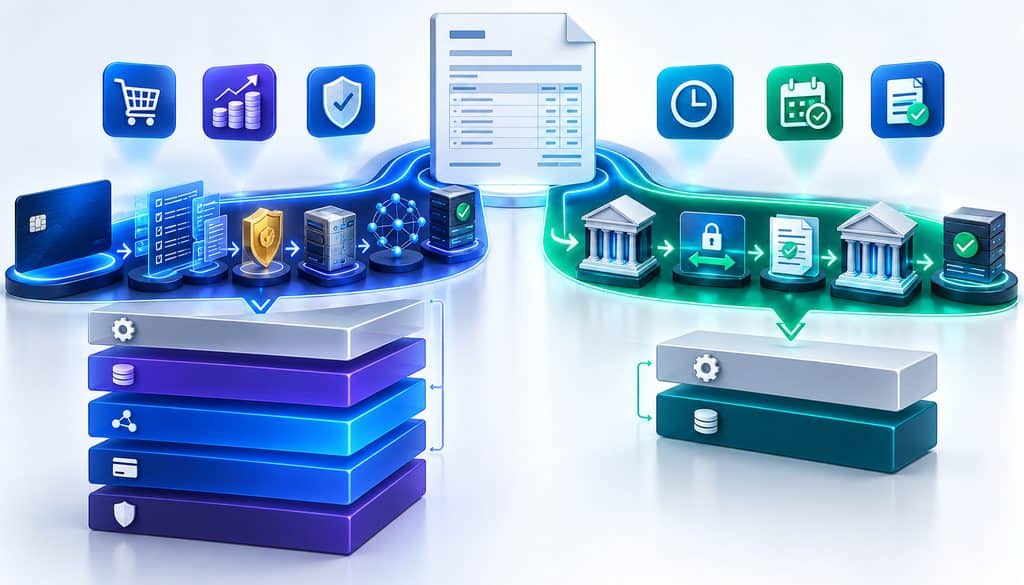
Cards may offer customer convenience, commercial-card rewards, purchasing controls, or additional working-capital time. Those benefits can matter to a B2B buyer.
But a percentage-based card fee can still produce a high dollar cost on an extremely large invoice—even when interchange is optimized.
Nacha’s B2B ACH payment guidance confirms that ACH is commonly used for paying and receiving supplier invoices, bills, and other business payments.
ACH pricing is provider-specific. Do not assume one universal per-transaction fee.
Compare:
- ACH transaction charges;
- card interchange;
- network fees;
- processor markup;
- reconciliation;
- payment timing;
- fraud controls;
- return exposure;
- buyer preference;
- commercial-card rewards or working-capital value.
Information about ACH transfer limits and how they work is also relevant when invoice sizes become unusually large.
A practical way to lower processing fees on large B2B invoice payments is therefore to optimize eligible card payments while keeping ACH available when the total-dollar economics favor bank-to-bank payment.
A practical card-plus-ACH policy
A business can:
- keep card acceptance available for customers that value it;
- make ACH available to buyers focused on payment cost;
- clearly communicate available payment methods;
- train sales and accounts-receivable teams on the cost differences;
- compare each method using actual merchant costs.
If a merchant is considering surcharging, cash discounts, steering, or acceptance restrictions, network rules and applicable law require a separate compliance review.
$10,000, $25,000, and $100,000 Invoice Examples
Scenario 1 — $10,000 commercial-card invoice
For businesses accepting cards on 10000 dollar invoices, identify the network and exact commercial product before applying any Large Ticket assumption.
A Mastercard Commercial Payments Account transaction of exactly $10,000 falls into Mastercard’s published Large Ticket 1 band at 1.20%.
That does not mean every $10,000 Mastercard transaction qualifies, and it does not create a Visa threshold.
The central issue when accepting cards on 10000 dollar invoices is card-product and program eligibility, not invoice value alone.
Scenario 2 — $25,000 Visa commercial invoice
Assume an eligible transaction currently qualifies at Visa Commercial Product 3.
Interchange:
$25,000 × 1.75% + $0.10 = $437.60
Assume illustrative processor markup of 0.35%:
$25,000 × 0.35% = $87.50
Assume another illustrative $20 of other card-related costs.
Total modeled cost:
$437.60 + $87.50 + $20 = $545.10
Now assume the same transaction legitimately qualifies for Commercial Product Large Ticket:
$25,000 × 1.30% + $35 = $360
Holding the hypothetical markup and other costs constant:
$360 + $87.50 + $20 = $467.50
Difference:
$545.10 − $467.50 = $77.60
This is an illustration of pass-through economics, not a merchant savings guarantee.
Scenario 3 — $100,000 Mastercard Commercial Payments Account invoice
At exactly $100,000, Mastercard’s published CPA Large Ticket 2 rate is 1.00%.
$100,000 × 1.00% = $1,000 interchange
Now assume purely for comparison that this particular merchant’s ACH provider charges $30 for a $100,000 payment.
$30 ÷ $100,000 × 100 = 0.03%
That $30 ACH assumption is illustrative, not a market standard.
The example shows why merchants wanting to lower processing fees on large B2B invoice payments should compare total dollars rather than assuming optimized card acceptance automatically beats ACH.
How to Measure Whether the Optimization Worked
Use actual settled data before and after the change.
Calculate:
Effective processing rate = total card-processing fees ÷ gross card volume × 100
For the targeted transaction population:
Large-invoice effective rate = fees attributable to analyzed large-ticket transactions ÷ settled large-ticket volume × 100
Track:
| Metric | Before | After | Difference |
| Large B2B card volume | |||
| Transaction count | |||
| Average invoice | |||
| Interchange cost | |||
| Network fees | |||
| Processor/acquirer markup | |||
| Gateway/data fees | |||
| Total fees | |||
| Effective rate |
Make the comparison like-for-like.
A month with a higher percentage of consumer rewards cards may cost more than a month dominated by purchasing cards even if the technical optimization works correctly.
Likewise, a higher average invoice can increase total fee dollars while the effective percentage falls.
Good measurement is necessary to prove that an effort to lower processing fees on large B2B invoice payments produced a real financial result.
Common Reasons Large Transactions Still Cost Too Much
The customer used a consumer card
A large invoice does not convert a consumer card into an eligible commercial product.
The commercial card does not qualify for the expected program
Different commercial products can have different interchange structures.
The processor is referring to the wrong program
Visa Commercial Product Large Ticket, STP, and Large Purchase Advantage are separate published categories.
Mastercard Large Market Credit and Commercial Payments Account treatment are also different.
Enhanced data is not reaching the network
ERP data only matters when the required information is properly transmitted through the gateway and acquiring connection.
Data is missing or malformed
Incorrect tax values, absent invoice fields, missing line items, or improper field mapping can undermine the intended qualification.
The transaction amount does not match the applicable program
Do not use Mastercard CPA bands as a universal commercial-card rule.
Authorization or clearing requirements were missed
Commercial interchange qualification can depend on more than card type and dollar value.
Merchant pricing masks the benefit
A fixed or bundled processor rate can prevent an underlying interchange reduction from appearing as a lower merchant rate.
MDR is being compared directly with interchange
That is not a like-for-like comparison.
When a finance team searches for B2B credit card fees high invoice problems, the cause is often one of three things: expensive underlying card economics, failed qualification, or merchant pricing that does not pass lower interchange through.
Questions to Ask Before Switching Processors
Before changing providers simply to lower processing fees on large B2B invoice payments, ask:
- Which current Visa Large Ticket or high-value commercial programs can our MID access?
- When you say “Visa Large Ticket,” which exact program do you mean?
- Which Mastercard Large Ticket programs can our transactions access?
- Do you support Mastercard Large Market Credit and Commercial Payments Account where applicable?
- Which commercial-card products qualify?
- Which Level 2 fields does your implementation require?
- Which Level 3 fields does your implementation require?
- Can our gateway transmit those fields through your acquiring connection?
- Is enrollment or special MID configuration necessary?
- Can you show the settled interchange category in transaction-level reporting?
- Does our pricing agreement pass lower interchange directly through?
- What markup remains above interchange?
- What happens when a transaction does not qualify?
- Are there gateway or integration charges for enhanced data?
- Can we test several real settled transactions before evaluating the result?
A provider should be able to explain the specific network program rather than simply saying “we support Level 3.”
Card Optimization or ACH? A Quick Decision Matrix
| Situation | Large Ticket / enhanced-card route | ACH | What to check |
| Eligible purchasing or commercial card | Strong candidate | Alternative | Exact network/product |
| Customer requires card | Optimize card path | Limited relevance | Data and qualification |
| Buyer values rewards/working capital | Card may provide value | Different buyer economics | Total relationship value |
| Merchant margin is thin | Compare carefully | Strong option to assess | Total dollar cost |
| Invoice is extremely large | Qualification matters | Direct comparison needed | All-in economics |
| ERP contains line-item data | Good integration candidate | Not dependent on Level 3 | Gateway mapping |
| Gateway cannot transmit required data | Card optimization may be limited | Useful alternative | Integration cost |
| Mastercard CPA transaction | Published bands may apply | Compare final dollars | Card-product identification |
Neither rail is universally better.
The right choice depends on the actual commercial product, invoice size, customer requirements, operational workflow, risk, reconciliation, and total cost.
FAQ
What is a Large Ticket interchange program?
A large ticket interchange program is a network-defined interchange treatment for eligible high-value commercial-card transactions. Qualification depends on the relevant card product, network program, amount where applicable, transaction conditions, data, and acquiring configuration.
Visa and Mastercard do not use identical programs, so the exact category should be verified after settlement.
Can I lower fees when accepting cards on a $10,000 invoice?
Possibly.
For businesses accepting cards on 10000 dollar invoices, Mastercard’s Commercial Payments Account program is especially relevant because its published Large Ticket 1 tier begins at $10,000.
That does not establish a universal threshold for other Mastercard commercial cards or for Visa. Identify the product and current interchange program before estimating savings.
Does every corporate card qualify for Large Ticket interchange?
No.
A card used for a business purchase is not automatically eligible. The network, commercial product, transaction amount, data, merchant configuration, and other program conditions can affect qualification. Ask the acquirer for the actual card product and settled interchange category.
Do I need Level 3 data for Large Ticket transactions?
Do not assume one rule applies to every program.
Enhanced data can affect commercial-card qualification, but Large Ticket and Level 3 are not identical concepts. Different Visa and Mastercard commercial programs can have different requirements.
Where the current public documentation does not disclose the precise requirement, confirm the current requirement with your acquirer or card network.
What is the difference between Level 2, Level 3, and Large Ticket interchange?
Level 2 generally adds enhanced summary business data. Level 3 provides more detailed purchasing and line-item information. Large Ticket is a network interchange treatment for qualifying high-value commercial transactions. The concepts may interact, but they perform different functions.
Can my existing processor enable Large Ticket processing?
Possibly.
Ask the processor to identify the exact Visa and Mastercard programs it supports, confirm any MID or acquiring configuration, document the enhanced-data path, and show the category achieved on settled transactions. A configuration problem may be fixable without changing processors.
Why is my B2B credit card fee still high after sending Level 3 data?
Level 3 data does not guarantee lower pricing.
The card may not be eligible for the target category, required data may not reach clearing correctly, another qualification requirement may fail, or a flat/bundled pricing model may prevent lower interchange from reducing the merchant-facing rate.
Is ACH cheaper than accepting a card on a $100,000 invoice?
It can be, but the answer depends on the merchant’s actual ACH arrangement.
Compare all-in card costs with ACH transaction fees, bank limits, fraud controls, return exposure, reconciliation, payment timing, and buyer preference. Do not use a generic ACH price as a substitute for the merchant’s real provider costs.
How can I tell whether a Large Ticket transaction qualified?
Check the settled transaction’s interchange-detail reporting.
Ask for the network, commercial card product, interchange category, amount, interchange dollars, processor markup, and other transaction fees. The settlement result is stronger evidence than a gateway setting.
A Practical Way to Lower Processing Fees on Large B2B Invoice Payments
To lower processing fees on large B2B invoice payments, begin with the commercial-card mix rather than a generic rate quote.
Identify the exact Visa and Mastercard products customers use. Then determine which current commercial or Large Ticket programs those transactions may legitimately access.
Next, map the required enhanced data from the ERP or invoicing platform through the gateway and acquiring connection. Verify the processor configuration, confirm how lower interchange is treated under the pricing agreement, and inspect actual settled transactions.
Finally, compare the resulting effective card cost with ACH on invoices where total-dollar expense matters most.
That sequence—identify the card, verify the program, transmit the correct data, test the transaction, measure the settlement result, and compare payment rails—is the most dependable way to lower processing fees on large B2B invoice payments without relying on vague “Level 3” or “Large Ticket” promises.